Signs Your Foundation Is Failing (Before It’s an Emergency)
Locally based foundation repair specialists serving the Seattle metro.
- Licensed & Insured in Washington
- Locally Owned, Seattle-Based
- Lifetime Manufacturer Pier Warranty
- Free On-Site Structural Inspections
- Engineered Repair Plans
Foundation problems in the Seattle metro almost never announce themselves with a single dramatic symptom. They build slowly through the wet season months, accumulate damage over years, and become obvious only after they’re expensive. The good news is the early warning signs are consistent — if you know what to look for, you can catch a foundation problem at the easy-to-fix stage rather than the structural-emergency stage. Here are the seven most common early warning signs we see during inspection visits across Bellevue, Renton, Kirkland, Redmond, Shoreline, Edmonds, Burien, and West Seattle.
1. Doors That Drag or Won’t Latch
The most consistent early warning. A door that used to close cleanly now drags on the floor, sticks against the jamb, or won’t latch without lifting. The cause is the door frame has shifted out of square because the foundation under it has settled. The symptom appears slowly — sometimes over years — and homeowners often adjust by trimming the bottom of the door or planing the jamb. Both adjustments hide the underlying problem, which is foundation movement. Check every door in the house at least once a year — if you have two or more that have started dragging in the past 3-5 years, schedule a free inspection.
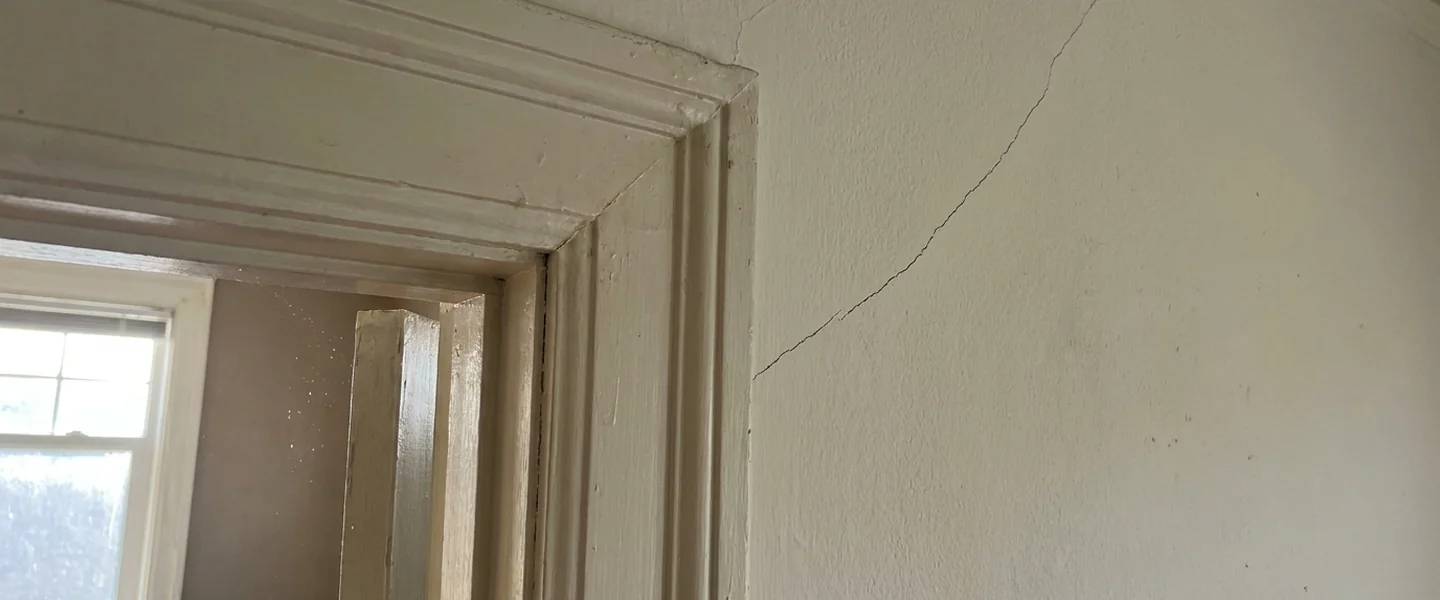
2. Cracks Radiating From Window and Door Corners
Drywall cracks that start at the upper corner of a window or door and run diagonally outward are the classic signature of foundation movement transferred into the upper structure. The cracks may be small (1/32 inch) initially and grow over time. They also tend to reopen after every repair attempt because the underlying foundation continues to move. The right fix is foundation stabilization, not repeated drywall patching.
3. Gaps Opening Between Walls and Floors (or Between Walls and Cabinets)
You notice a gap appearing along the baseboard, between the wall and the floor, or between a kitchen cabinet and the adjacent wall. The gap wasn’t there a few years ago. The cause is differential settlement — one part of the foundation has dropped relative to another, and the structure above has shifted to accommodate. The gap will continue to grow as long as the settlement continues. Document the gap with photos and a tape-measure scale so you can monitor progression.
4. Stair-Step Cracks in CMU Foundation Walls
CMU (concrete masonry unit) foundation walls — common in Seattle-area homes from the 1940s through the 1970s — develop stair-step cracks when one part of the foundation moves relative to another. The crack follows the mortar joints diagonally, stepping across multiple blocks. This pattern is almost always structural and warrants a free inspection.
5. Horizontal Cracks in Basement Walls at Approximately Mid-Wall Height
The classic signature of hydrostatic pressure bowing. The wall is being pushed inward by saturated soil outside, and the crack forms at the highest-stress point — typically mid-height between the floor and the sill. The wall may have visible inward bow when sighted along its length. This pattern requires structural reinforcement (carbon fiber straps or wall anchors) before the wall fails. Seattle-area daylight basements built before 1975 are particularly susceptible.
6. Basement Water Entry During Heavy Rain
Water on the basement floor, efflorescence (white powdery deposits) on the foundation walls, musty smells during the wet season, or visible damp spots after atmospheric river events. The water is finding its way through cracks, cold joints, or failed exterior waterproofing. Seattle’s wet season delivers months of sustained rain, and any compromised entry point will leak repeatedly. Interior drainage and sump pump installation is the standard Seattle fix; addressing the wall cracks at the same time prevents the leak from migrating to a new location.
7. Sloping Floors You Can Detect With a Marble or a Level
Set a marble on the floor in the middle of a room. If it rolls consistently in one direction, the floor is sloped. The slope can also be measured directly with a 4-foot level — set the level on the floor and look at the bubble. A slope of 1/2 inch over 8 feet (about 0.5%) is within normal tolerance for most older Seattle-area homes. A slope of more than 1 inch over 8 feet (about 1%) usually indicates structural settlement that warrants engineered repair. The most reliable measurement uses a digital laser level taking elevations at multiple points across the room.
Why These Signs Are More Common in Seattle
The Seattle metro’s combination of Pacific Northwest wet season (October-April with 30-50 inches of annual rainfall concentrated in those months), glacial till substrate that holds water and transmits hydrostatic pressure, documented landslide hazard zones across thousands of homes, Cascadia subduction zone seismic considerations, and a housing stock that includes thousands of 1920s-1970s homes with foundations built before modern waterproofing and engineering standards makes the area one of the more demanding metros in the country for an aging residential foundation. The signs above will appear faster and accumulate worse here than they would in a drier climate. The flip side: properly engineered foundation repair produces a more durable improvement here than it would in a drier climate, because the wet-season water loading that drives the problem also tests the repair every year.
Bottom Line
If you recognize one of these seven signs in your Seattle-area home, schedule a free inspection. Catching the problem early is dramatically cheaper than waiting until structural damage compounds. Call (206) 736-1337 for a free on-site structural inspection with a written, itemized estimate delivered within 24-48 hours.
Questions to Ask the Contractor When You Schedule
- Does the same specialist do the inspection and the install?
- What materials do you use and are they specified by brand and model in the quote?
- Is the workmanship warranty transferable to a new homeowner?
- Will the work require engineering documentation or a city permit?
- Will you provide a written second opinion on another company’s quote, free of charge?
- Can you provide local references from Seattle-area jobs in the past 12 months?
Common Misconceptions About Foundation Warning Signs
“If I can’t see it from outside, it’s not a problem.”
Most foundation damage develops in the basement, crawlspace, or below grade. By the time you can see the problem from the outside, it has usually progressed considerably.
“Doors stick because of humidity.”
Wood doors do swell with humidity, but seasonal stick is reversible — the door binds in summer and loosens in winter. Foundation-driven stick is permanent and progressive. If the door has stuck consistently for more than a year, foundation movement is the likely cause.
“Sloping floors are normal in old houses.”
Some slope is common in older homes. More than 1 inch of slope over 8 feet of run is not normal and indicates active structural concern.
“I’ll deal with it when I sell.”
This is the most expensive path. Buyers’ home inspectors flag foundation issues, and an unrepaired foundation problem either kills the deal or forces a price reduction that exceeds the repair cost. Getting the work done with engineered documentation before listing produces a better outcome.
Service Areas We Cover
We serve Seattle and the entire Puget Sound metro. Click your suburb for local details and our typical findings in your housing stock:
Free Foundation Inspection in Seattle
Same-week appointments. No high-pressure sales. Serving Seattle and surrounding areas including Bellevue, Renton, Kirkland, Redmond, Shoreline, Edmonds, Burien, West Seattle.