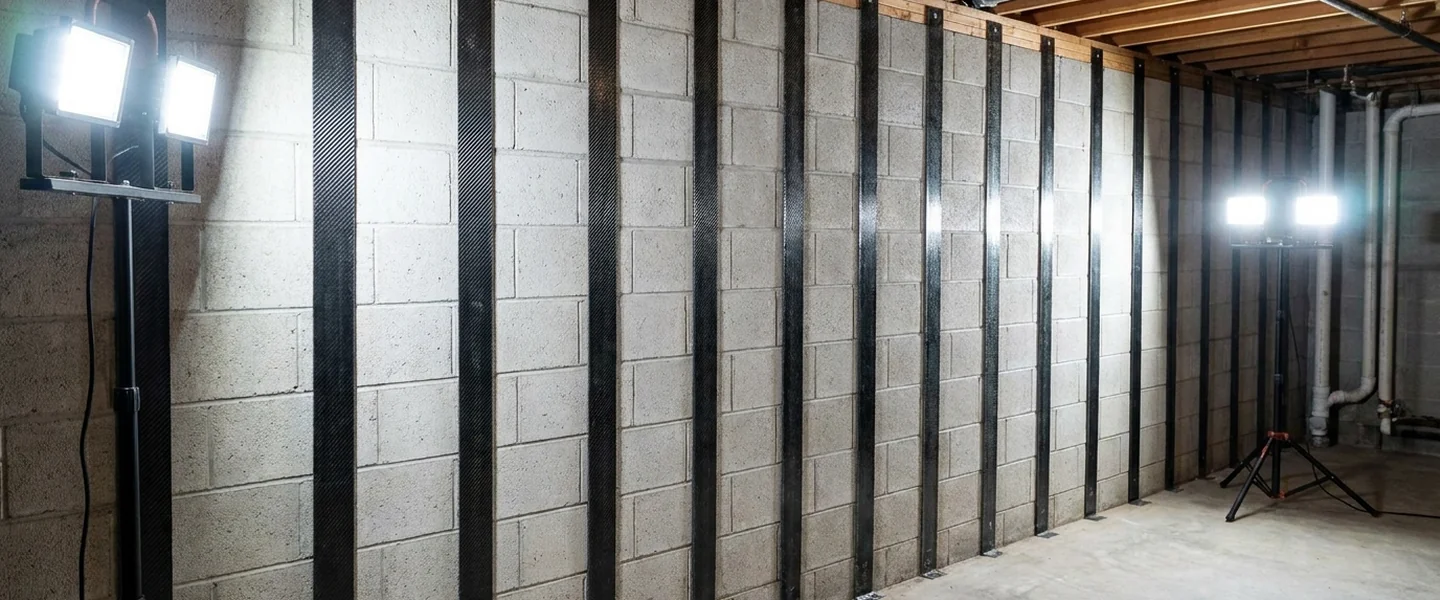
Bowing Wall Stabilization in Seattle, Washington
Carbon fiber strap and wall anchor systems for bowing or leaning foundation walls — engineered fix with no excavation.
- Licensed & Insured in Washington
- Locally Owned, Seattle-Based
- Lifetime Manufacturer Pier Warranty
- Free On-Site Structural Inspections
- Engineered Repair Plans
What Bowing Wall Stabilization Means in Seattle, WA
Bowing wall stabilization is the process of arresting inward movement of a foundation wall using carbon fiber straps (for walls bowed less than 2 inches) or steel wall anchors (for walls bowed more than 2 inches or with active accelerating movement). In Seattle, hydrostatic pressure from saturated clay-rich soils is the most common cause of wall bowing, particularly in basements built in the 1950s-1970s before proper exterior waterproofing and perimeter drainage were standard. The repair is no-excavation for carbon fiber systems and minimal-excavation for wall anchors.
The Seattle metro’s specific geology and climate make this work especially impactful. We see homeowners in Bellevue, Renton, Kirkland, Redmond, Shoreline, Edmonds, Burien, and West Seattle go from chronic basement seepage, accelerating wall movement, visible settlement, and unusable basement square footage to fully waterproofed, structurally stable, and warrantied foundations within a week to three weeks of starting the install. The before/after measurements tell the whole story — most Seattle foundations come out of the wet season measurably drier, with stabilization confirmed by repeat displacement readings at 6 and 12 months.
Project Details
| Service Area | Seattle, WA plus Bellevue, Renton, Kirkland, Redmond, Shoreline, Edmonds, Burien, West Seattle |
|---|---|
| Install Days | 1-2 days (depending on scope, access, and engineering review) |
| Materials Used | Steel push and helical piers; carbon fiber strap systems; primary plus battery-backup sump pumps; polyurethane and epoxy crack injection; 4-inch perforated PVC drainage |
| Warranty | Lifetime manufacturer warranty on piers; 25-year transferable workmanship warranty on the install |
| Crew Size | 2-4 technicians, including the specialist who did your inspection |
| Permit Required | Yes for piering and egress windows; sometimes yes for major bowing wall repair; usually no for crack injection and interior drainage |
| Engineering | Stamped PE letter included where required by code or recommended by the scope |
| Investment | Quoted per job after a free on-site inspection — every estimate is itemized in writing |
Our Process
Every bowing wall stabilization job in the Seattle metro follows the same disciplined process. We do not skip steps because of scheduling pressure, and we do not bid jobs that require shortcuts.
Step 1: Displacement measurement
We measure wall displacement with a laser level and reference plumb-bob at multiple points along the wall, determine the magnitude and pattern of bowing, and identify whether movement is active (measurable progression year-over-year) or dormant.
Step 2: Engineering review
For any wall with displacement exceeding 1 inch, we obtain a stamped Professional Engineer letter that specifies the repair method, strap or anchor spacing, and load calculations. Engineering documentation is included in the written quote.
Step 3: Wall surface prep
The interior face of the foundation wall is ground smooth at each strap location and cleaned of any coatings or loose material. The bond surface must be sound concrete for the carbon fiber to develop its design strength.
Step 4: Carbon fiber installation
High-strength carbon fiber straps are bonded to the wall with engineered epoxy at the spacing specified in the PE letter. Straps run from the floor slab to the sill plate, transferring lateral loads into the structural frame above and below.
Step 5: Wall anchor installation (alternative)
For walls with greater displacement or active movement, steel wall anchors are installed through the foundation wall with an exterior earth anchor plate. The interior anchor plate is connected to the exterior plate with a steel rod, allowing controlled inward tension to arrest movement and (in some cases) partially straighten the wall over time.
Step 6: Surface finish
Carbon fiber straps can be painted to match the wall, and the installation is unobtrusive in unfinished basements. Anchor plates remain visible but compact (4×4 inch interior face).
Step 7: Monitoring
We provide a follow-up displacement measurement at 6 months and again at 12 months to confirm the wall has stabilized. Both visits are included in the original quoted price.
Materials We Use
We are loyal to materials that perform in the Pacific Northwest’s wet climate and on the glacial till that underlies most of the metro. The list is short and intentional:
| Piers | Steel push piers and helical piers (Earth Contact Products or equivalent, ICC-ES listed) |
|---|---|
| Carbon Fiber | High-strength carbon fiber strap systems with engineered epoxy bonding |
| Sump Pumps | Primary submersible (1/3 to 1/2 HP cast iron) plus battery-backup secondary with sealed AGM battery |
| Crack Injection | Polyurethane (for active leaks) and structural epoxy (for dormant cracks) — pressure-injected with bonded ports |
| Drainage | 4-inch perforated PVC in clean drain rock, wrapped in filter fabric; sealed sump pits with gasketed lids |
Common Scenarios We See in Seattle Foundations
The 1960s Bellevue Daylight Basement
Hydrostatic pressure from saturated glacial till has bowed the uphill foundation wall inward by 3/4 of an inch. Seepage at the wall-floor cold joint shows up every November. Solution: carbon fiber wall stabilization plus interior French drain feeding a primary-plus-backup sump pump.
The 1925 Kirkland Craftsman Near Lake Washington
Original concrete foundation walls weeping at the cold joint, efflorescence year-round, high water table along the Lake Washington corridor. Solution: interior perimeter drainage, sealed sump pit with battery backup, polyurethane injection of the worst cracks.
The West Seattle Bluff-Edge Home
Slow rotational settlement toward Puget Sound, documented Landslide Hazard zone, 1/2 inch of differential between rooms measured with a laser level. Solution: engineered helical piers on the downhill side with stamped PE letter, controlled re-leveling over 5-7 days.
The Redmond Subdivision on Filled Wetland
Newer construction (built 2005-2015) on fill soils that are still consolidating, with stair-step cracking in CMU walls and door-frame gaps opening up. Solution: helical pier installation under the affected footing, controlled re-leveling, crack injection on the stabilized walls.
Why Seattle Homes Need This Service
The Seattle metro sits on glacial till — a dense, clay-rich, poorly draining substrate that holds water and transmits hydrostatic pressure directly into basement walls. Add Pacific Northwest atmospheric river events (multiple per season, often dropping 2-4 inches in 24 hours), documented landslide hazard zones across West Seattle, Magnolia, Edmonds, and Shoreline, and Cascadia subduction zone seismic considerations under every home built before 1977, and the case for engineered foundation work becomes self-evident. Basements above unrepaired foundations flood. Bowing walls accelerate. Settled houses get worse. Bowing Wall Stabilization addresses the specific failure mode in your home with a single integrated install.
Warranty in Detail
Our warranty has three components, and we want you to understand each before you sign anything:
Manufacturer materials warranty. Steel push piers and helical piers carry a lifetime manufacturer warranty against material defects (ICC-ES listed products from Earth Contact Products and equivalents). Carbon fiber strap systems carry a 25-year manufacturer warranty. Sump pumps carry a 3-5 year manufacturer warranty depending on the model. Crack injection materials carry a structural lifetime warranty when installed to manufacturer specification.
Workmanship warranty. We warrant our installation work for 25 years and that warranty is transferable to a new homeowner. The transfer is paperwork only — we don’t charge a transfer fee. We’ve had warranty calls; we have always honored them. Every install is photographed at completion so there is no dispute about what was installed where.
What’s explicitly NOT covered. New cracks or movement in areas of the foundation we did not repair. Damage caused by subsequent renovation work in the basement or against the foundation. Wall failure caused by exterior grading changes made after our work (adding hardscape against the foundation, removing perimeter drainage). We tell you these up front because we’d rather lose a sale than have a warranty dispute later. Most national franchises bury these exclusions in fine print; ours is in the written estimate in plain English.
How We Quote (Without Quoting on the Phone)
We do not quote bowing wall stabilization over the phone. We’ve tried, and the resulting numbers were almost always wrong — sometimes too high, sometimes too low, and always frustrating for the homeowner who got a different number from the specialist on inspection day. So we don’t do it. Instead, we schedule a free on-site inspection within 48 hours, walk the foundation, measure displacement, photograph conditions, review exterior drainage, and deliver a written itemized estimate within 24-48 hours of the visit. The estimate spells out every component, every material brand and model, every linear foot of coverage, the timeline by day, the engineering and permitting if applicable, and the warranty terms. You take it home and decide on your own time. No follow-up call, no “expiring tonight” discount, no pressure. If the price is acceptable, you sign and schedule. If it isn’t, no hard feelings.
After the Bowing Install
We follow up at 30 days, 6 months, and 12 months on every bowing wall stabilization job in the Seattle metro. The 30-day check verifies the system is working as designed (sump pumps cycling correctly, drains flowing, carbon fiber bonded, piers carrying load). The 6-month check is timed to verify performance through the wet-season peak. The 12-month check is a more thorough inspection with new displacement and moisture readings, and a written follow-up report you can keep for resale documentation. All three visits are included in the original quoted price. If anything seems off in between — accelerated movement, new seepage, a sump pump cycling more than expected — call us. The same specialist who did your install handles the call.
Seattle Engineering Documentation
Where the scope requires it, we provide a stamped Professional Engineer letter at no additional charge to the homeowner. Engineering documentation matters at resale — a Seattle home with a documented engineered repair, photographs of the install, and a transferable workmanship warranty appraises better and inspects cleaner than a home with an undocumented or DIY repair history. The PE letter, the permit close-out, and our workmanship warranty are all delivered to the homeowner as part of the final documentation packet.
Service Areas
We perform bowing wall stabilization across Seattle and these surrounding suburbs: Bellevue, Renton, Kirkland, Redmond, Shoreline, Edmonds, Burien, West Seattle.
Frequently Asked Questions
How long does bowing wall stabilization take in Seattle?
For a typical Seattle-area home, this service takes 1-2 days on site. The exact timeline depends on access, existing conditions, and any engineering or permit requirements that need to happen first. We give you a day-by-day schedule with the written quote.
Will I need to be home during the install?
Most of the work happens at the foundation or basement level, so you don’t need to be home for the full duration. We do need you home for the initial walk-through and the final walk-through, both of which take about 30 minutes.
Is there a transferable warranty?
Yes. The manufacturer materials warranty (lifetime on steel push and helical piers, 25-year on Stego-grade vapor barriers, 5-year on sump pumps) plus a 25-year transferable workmanship warranty on the install. Transfer to a new homeowner is paperwork only — no fee.
Will this work in older Seattle homes?
Yes — actually older Seattle homes are where this work has the biggest impact. Pre-1970 housing stock in West Seattle, Kirkland, downtown Edmonds, and the older Bellevue neighborhoods predates modern exterior waterproofing and proper perimeter drainage. We’ve done this work in hundreds of historic-district homes without disturbing original architectural finishes.
How fast can you start?
After the free structural inspection, the written quote arrives within 24-48 hours. Most installs are scheduled within 7-21 days of acceptance, depending on any engineering review or permit requirements. Emergency situations — accelerating wall movement, active water entry, structural collapse risk — move to the front of the queue.
Do you handle the permits?
Yes. Where the City of Seattle, King County, or Snohomish County requires a permit (typically for piering, major structural repair, or egress windows), we pull and close the permit. Crack injection, carbon fiber stabilization for minor bowing, and interior basement waterproofing typically do not require permits in the metro.
Can this be done during the wet season?
Yes. Interior basement waterproofing, crack injection, carbon fiber stabilization, and sump pump installation are all interior work that proceeds normally during the Washington wet season. Piering and egress window work involve some exterior excavation and we schedule those during drier weeks when possible, but the work proceeds year-round.
Does homeowners insurance cover bowing wall stabilization in WA?
Sometimes, depending on the cause of the damage. Sudden events (a burst pipe under the slab, a tree falling on the foundation) are often covered. Slow-developing conditions (settlement, hydrostatic pressure bowing, long-term water entry) are typically excluded. We provide written documentation that homeowners can submit to their insurer; the insurer makes the final coverage call.
What if I find something wrong after the install?
Call us. The same specialist who did your install handles the follow-up. We do a 30-day check-in, a 6-month check-in for stabilization work, and a 12-month check-in on every job, included in the quoted price.
Why no price on the website?
Because every Seattle foundation problem is different and a phone quote would be wrong. We give you a written, itemized estimate after a free on-site structural inspection. That estimate is the real number — not a ‘starting at’ bait price.
Service Areas We Cover
We serve Seattle and the entire Puget Sound metro. Click your suburb for local details and our typical findings in your housing stock:
Get a Free Quote for Bowing Wall Stabilization
Same-week appointments. No high-pressure sales. Serving Seattle and surrounding areas including Bellevue, Renton, Kirkland, Redmond, Shoreline, Edmonds, Burien, West Seattle.
What You Get in Our Quote vs. the Lowball Bid
We don’t compete on the lowest sticker price — we compete on the quote that gets the job actually done. Here is what is included in every quote we write, and the cut-corners that show up in cheaper bids.
Included in our written quote
- Engineer-style elevation + crack assessment
- Soil and drainage evaluation
- Written quote with pier counts + warranty terms
- Photo documentation of every crack/movement
- Permit-pulling where required
- Post-install elevation re-check
Cut corners in the lowball bid
- Free-quote with no actual inspection
- Pier-count guesses without measurements
- Subcontracted installation crews
- Warranties that exclude common failure modes
- Pressure to sign at the kitchen table
- Same-day pricing tricks