Does Homeowners Insurance Cover Foundation Repair in Washington?
Locally based foundation repair specialists serving the Seattle metro.
- Licensed & Insured in Washington
- Locally Owned, Seattle-Based
- Lifetime Manufacturer Pier Warranty
- Free On-Site Structural Inspections
- Engineered Repair Plans
“Will my homeowners insurance cover this?” is one of the first questions every Seattle-area homeowner asks when they get a foundation repair quote. The answer is “sometimes, depending on the cause” — and the documentation we provide as part of the inspection visit often determines whether a claim succeeds. This post explains how Washington homeowners insurance treats foundation repair and what to do to maximize your chances of coverage when coverage is available.
What Standard Washington Homeowners Insurance Generally Covers
Most standard Washington homeowners insurance policies (HO-3 or HO-5 form) cover foundation damage caused by “sudden and accidental” events. The common covered scenarios are: a burst pipe under the slab that erodes soil and causes settlement, a tree falling on the foundation, a vehicle impact on a foundation wall, accidental discharge of water from an internal plumbing system that damages the foundation, and fire damage to foundation framing. These events are typically covered subject to your policy’s deductible.
What Standard Washington Homeowners Insurance Generally Does Not Cover
The exclusions matter more than the inclusions. Standard Washington homeowners insurance generally excludes: settlement, cracking, or shifting of the foundation caused by gradual soil movement or consolidation; damage from hydrostatic pressure or surface water entering the home; damage from earth movement, including landslides, mudflows, and earthquakes (these require separate earthquake or landslide coverage); damage from inadequate original construction, age, or wear; and damage from improper grading or drainage. In practice, this means most Seattle-area foundation repairs — the slow-developing settlement, bowing, and seepage we see on a daily basis — are NOT covered under standard policies.
The reasoning behind these exclusions is that insurance is designed to cover sudden unforeseen events, not gradual deterioration that the homeowner had the opportunity to detect and address. Whether that reasoning seems fair to you or not, the policy language is what determines coverage.
When Coverage Sometimes Applies
Even with the standard exclusions, coverage sometimes applies in Seattle-area foundation cases. The pattern is: a sudden and accidental event caused the damage, and the damage is documented as starting at a specific point in time rather than being a slow accumulation. A burst pipe under the basement slab is the classic covered scenario — the leak began at a specific date, the eroded soil under the slab caused the foundation to crack, and the repair scope is directly tied to that event. We’ve seen Seattle-area homeowners successfully claim repairs from supply-line leaks, sewer-line breaks, water-heater failures, and sprinkler-line breaks that damaged adjacent foundations.
Documentation is everything in these cases. Photos of the leak, plumber’s records of the repair, and a written explanation from the foundation specialist tying the damage to the plumbing event all support the claim. Without that documentation, the insurer often categorizes the damage as gradual settlement and denies the claim.
Earthquake and Landslide Endorsements
Washington homeowners can purchase separate earthquake coverage and (more rarely) landslide coverage as endorsements to a standard policy. These coverages typically have separate deductibles, often as high as 10-15% of the home’s insured value. In Cascadia subduction zone seismic country, earthquake coverage is worth evaluating — particularly for older homes that have not been retrofitted. We don’t sell insurance, but we recommend that Seattle-area homeowners review their earthquake coverage status periodically and consider the trade-off between premium cost and potential exposure.
Landslide coverage is harder to find and significantly more expensive in Seattle Department of Construction and Inspections Landslide Hazard zones. Many insurers will not write standalone landslide coverage in documented hazard zones; some write it only as part of a larger comprehensive policy. If your property is in a hazard zone, this is worth discussing with your agent — and worth considering when you evaluate the cost-benefit of foundation work that proactively addresses slope-driven movement.
What to Do If You Think You Have a Covered Claim
Document the event. Take photos. Note the date. Save all related records — plumbing repair invoices, fire department reports, police reports for vehicle impact. Call the insurance company promptly — most policies require timely notice of claims, and waiting can become a coverage issue.
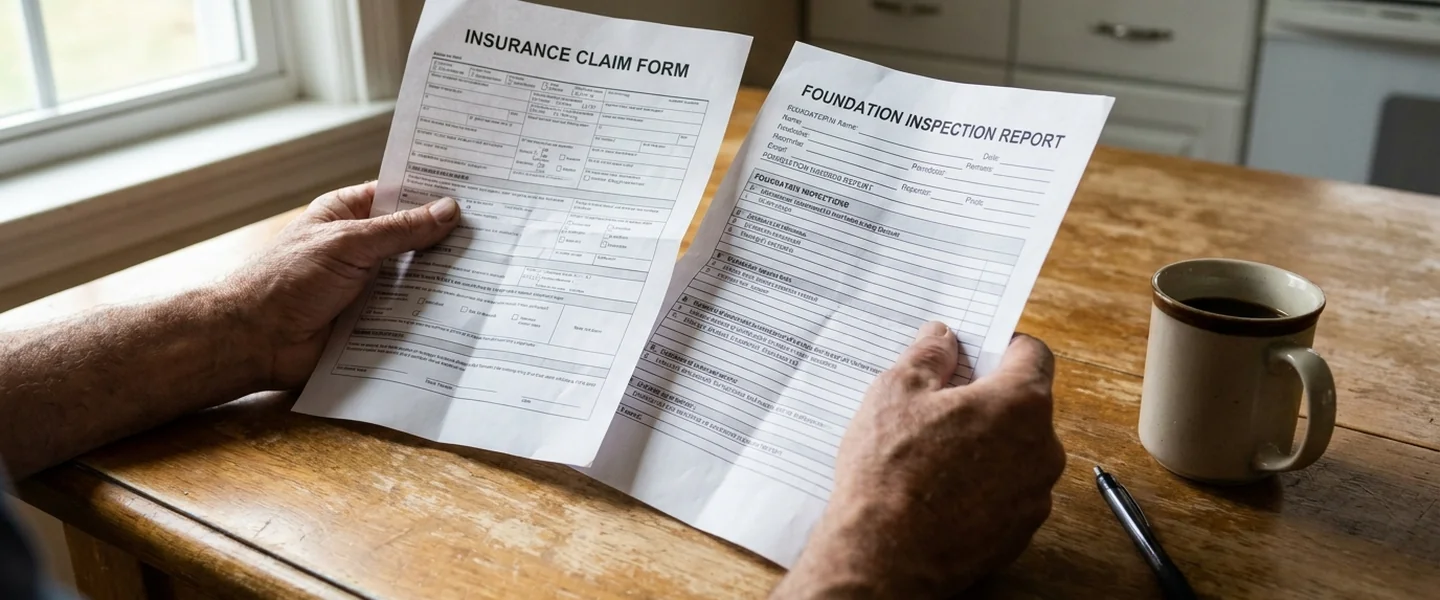
Get a written inspection report from a foundation specialist. The report should describe the damage, identify the likely cause, and (where applicable) link the damage to the covered event. We provide these reports as part of our standard inspection visit at no additional charge to the homeowner.
Be prepared for the insurance company to send their own adjuster or engineer. The adjuster will look at the same evidence and reach their own conclusion — which sometimes differs from the homeowner’s contractor. Where there is disagreement, the homeowner has the right to retain an independent engineer at their own expense to advocate for the claim.
If the claim is denied, review the denial letter carefully. Insurers sometimes deny claims that are actually covered, and the denial language signals what additional documentation might change the decision. Washington has a robust insurance commissioner’s office that handles consumer complaints about denied claims; that office can be a useful resource if you believe a denial is incorrect.
What to Do If You Have an Uncovered Claim
Most Seattle-area foundation work is paid for out of pocket because the underlying cause is gradual rather than sudden. This is the typical case, not the exception. When that’s the situation, the question becomes how to fund the repair — and there are several common paths.
Out-of-pocket. Many homeowners pay for foundation work directly. The cost-benefit math usually favors immediate repair: deferring foundation work allows the underlying problem to compound, often increasing the eventual repair cost by 30-100%.
Home equity line of credit (HELOC). A HELOC against the home’s equity is a common funding mechanism for major home repairs. Interest is sometimes tax-deductible (consult a tax professional); rates are typically lower than personal loans or credit cards.
Contractor financing. Many foundation specialists, including us, work with home-improvement financing providers (Hearth, Synchrony, GreenSky) that offer 0% promotional periods of 12-18 months on qualifying projects. Most Seattle-area homeowners qualify; we never adjust the quoted price based on financing terms.
Sale-conditional repair. If you’re selling the home, sometimes the buyer agrees to a price reduction that funds the repair after closing, or the seller funds the repair as a closing condition. The right path depends on the market and the buyer’s flexibility.
Seattle-Specific Considerations
The Seattle metro’s combination of Cascadia subduction zone seismic risk, documented landslide hazard zones, high water table, and aging housing stock means that foundation issues are common and most are not covered by standard homeowners insurance. The most productive use of insurance considerations is preventive — make sure you have appropriate earthquake coverage, evaluate landslide coverage if you’re in a hazard zone, and document any sudden events that affect your foundation promptly so they’re available if a future claim becomes necessary.
Resale considerations also matter. A foundation with documented engineered repairs, transferable warranties, and PE letters appraises better and inspects cleaner than one with undocumented or DIY repair history. If you’re going to do foundation work, do it with engineering documentation so the work supports the future value of the home regardless of insurance coverage on the original event.
Common Misconceptions About Insurance and Foundations
“My homeowners insurance will cover everything.”
Standard Washington policies cover sudden events, not gradual settlement. Most Seattle-area foundation work is not covered. Read your policy carefully or ask your agent for clarity before assuming coverage applies.
“If insurance won’t cover it, it’s not worth doing.”
The cost-benefit math usually favors doing the work whether insurance covers it or not. Deferred foundation repair almost always increases the eventual cost.
“I should file a claim and see what happens.”
Sometimes worth doing, but be aware that frequent claims can affect future policy renewals and premiums even if the claim is denied. A consultation with your agent before filing is usually a good idea.
“All insurers are the same on foundation coverage.”
Not quite. The standard exclusions are broadly consistent, but specific policy language varies and some insurers offer endorsements that others don’t. If foundation coverage matters to you, shop the endorsements specifically when you renew.
Questions to Ask Your Insurance Agent
- What types of foundation damage does my current policy cover?
- What is the deductible for foundation-related claims?
- Do I have earthquake coverage? What’s the deductible?
- Is landslide coverage available, and what would it cost?
- If I have a covered claim, what documentation do you require?
- Does filing a claim affect my policy renewal or premium even if denied?
Bottom Line
Most Seattle-area foundation repair is not covered by standard homeowners insurance because the underlying cause is gradual rather than sudden. Where a covered event has caused damage, documentation is everything — photos, dates, written reports linking the damage to the event. We provide written inspection reports as part of every free inspection, and they’re yours to use whether you hire us or file an insurance claim. Call (206) 736-1337 to schedule a free on-site inspection with a written report you can share with your insurer.
Service Areas We Cover
We serve Seattle and the entire Puget Sound metro. Click your suburb for local details and our typical findings in your housing stock:
Free Foundation Inspection in Seattle
Same-week appointments. No high-pressure sales. Serving Seattle and surrounding areas including Bellevue, Renton, Kirkland, Redmond, Shoreline, Edmonds, Burien, West Seattle.